For people who work with Claude
Claude is brilliant.
And it forgets everything.
Every conversation starts from zero — Claude Desktop, Claude Code, all of them. Mnemosyne OS runs on your machine and keeps what you've already thought: notes, decisions, sessions, years of writing. One MCP connection later, Claude can ask your memory — and it answers locally, from your vaults.
One command, no cloud between you
A real MCP server, published, MIT.
Mnemosyne OS publishes @mnemosyne_os/mcp, an open-source MCP server on npm. Claude Desktop and Claude Code speak MCP natively: plug it in and your assistant gains tools to search your memory by meaning, ask for answers grounded in your chronicles, and — if you allow it — write new memories into them.
Claude Code, one line:
claude mcp add mnemosyne -- npx -y @mnemosyne_os/mcpClaude Desktop, in claude_desktop_config.json:
{
  "mcpServers": {
    "mnemosyne": {
      "command": "npx",
      "args": ["-y", "@mnemosyne_os/mcp"]
    }
  }
}Beyond recall
Talk with your memory. Ideas come out.
Recall is the floor, not the point. Through MCP, Claude can hold a real working dialogue with your memory: query it, ask it for grounded syntheses, surface resonances — chronicles from distant domains that answer each other. A note from March, a session from last year, a half-buried decision: put in the same room, they start suggesting things.
That's where it gets interesting for builders: original dev ideas don't come out of a blank prompt — they come out of your own corpus colliding with itself. Claude does the walking; the ground is yours.
Governed, not vacuumed
Claude sees the vaults you grant. Nothing else.
Your memory is organized in vaults — one per domain of your life. Each has a scope and a protection level; a vault marked private stays out of reach, even for a well-meaning agent. Mnemosyne never deletes silently and never blends your domains without you.
And one honest sentence, because sovereignty is a matter of precision: the engine runs locally, but what Claude reads through MCP enters your Claude conversation, wherever that runs. You choose what crosses — that is exactly the point.
What it plugs into
Your memory, as Claude reaches it.
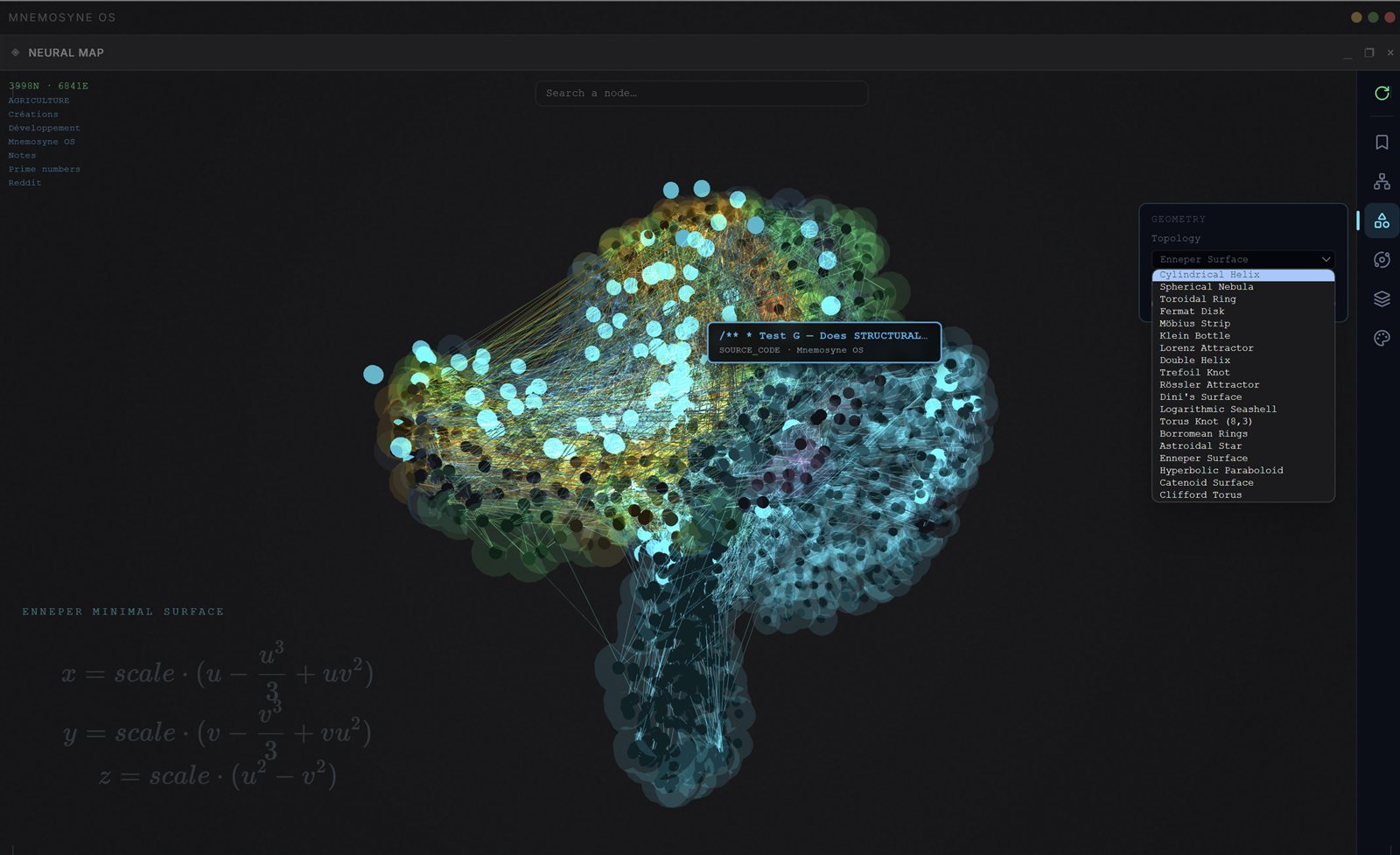
Your assistant stops starting from zero.
And its memory stays in your house.