MnemoHub
One use,
one app.
Mnemosyne OS is versatile: each app gives it a new use. With MnemoReader, it reads a book aloud to you. With MnemoVulns, it finds the known flaws in your code. With MnemoResto, it runs a restaurant's till. Each app runs on your machine and keeps what it makes in its own vault.
Explore the 28 apps, or build the one you are missing.
- 22 in the official hub
- 6 outside the hub
- catalog signed on 2026-10-21
For you if I'm a developerI'm a studentI work in healthI do researchI run a businessIt's for home
Catalog
All the apps.
✓ In the official hub 22
Reviewed and signed by Mnemosyne OS. You install them in one press from MnemoHub, with no limit and no license.
- ✓ On MnemoHub
- ✓ On MnemoHub
- ✓ On MnemoHub
- ✓ On MnemoHub
- ✓ On MnemoHub
- ✓ On MnemoHub
- ✓ On MnemoHub
- ✓ On MnemoHub
- ✓ On MnemoHub
- ✓ On MnemoHub
- ✓ On MnemoHub
- ✓ On MnemoHub
- ✓ On MnemoHub
- ✓ On MnemoHub
- ✓ On MnemoHub
- ✓ On MnemoHub
- ✓ On MnemoHub
- ✓ On MnemoHub
- ✓ On MnemoHub
- ✓ On MnemoHub
- ✓ On MnemoHub
- ✓ On MnemoHub
Outside the hub 6
Published from their own repo, with no review and no signature. You add them with their link. Without a license, you can add one app this way.
No app matches this search.
Install
Add an app to Mnemosyne OS.
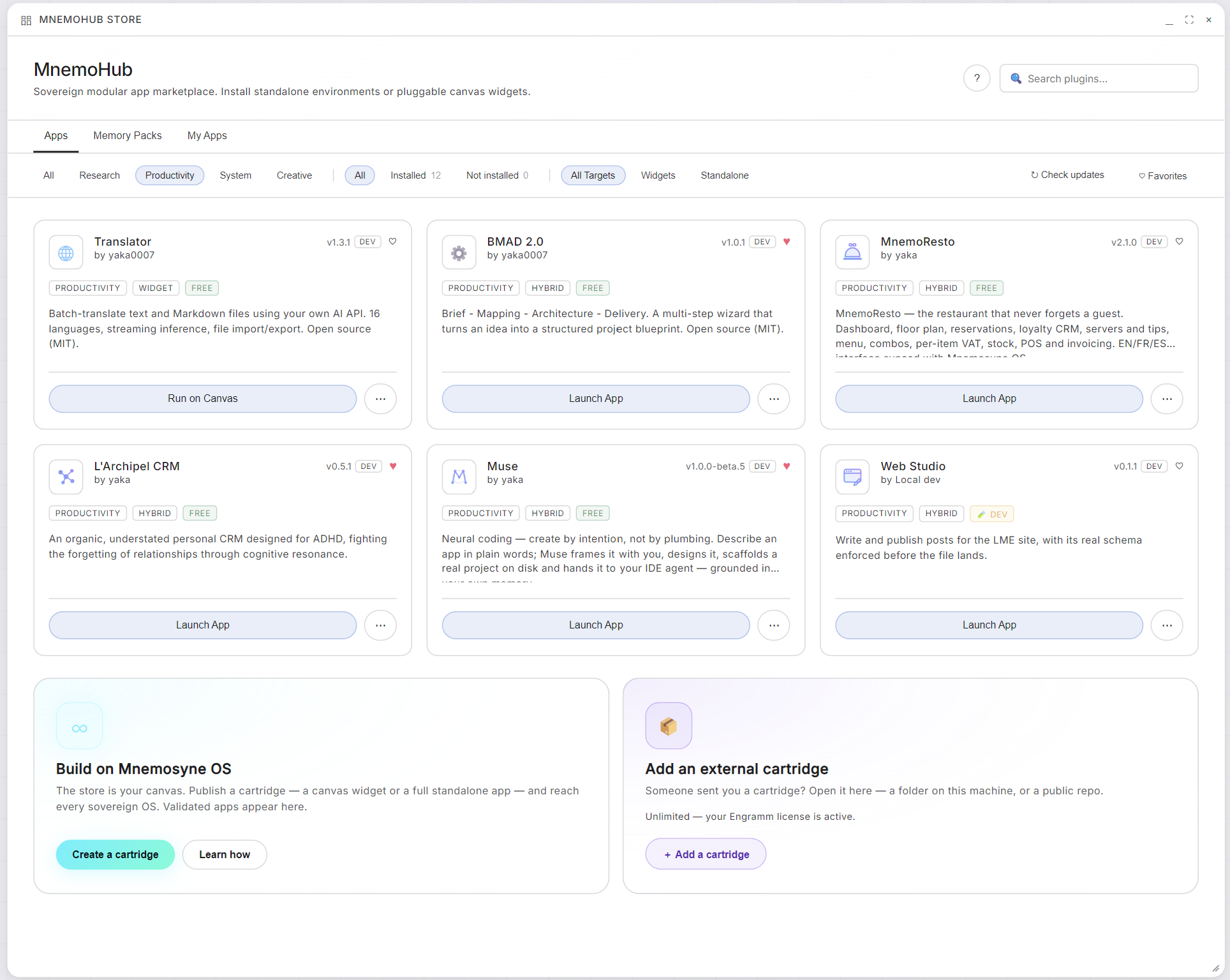
Official hub: from MnemoHub
- Open Mnemosyne OS, then MnemoHub in the dock.
- Find the app and press Install.
- It opens in its own window, with its own vault.
Outside the hub: from a repo link
- On this page, press Copy link on the app.
- In MnemoHub, choose Add an external cartridge, then A repo.
- Paste the link. Mnemosyne OS reads the manifest and shows the name, the version and the permissions.
- Check them, then install.
A link works for any public GitHub, GitLab or Bitbucket repo that carries a Mnemosyne OS manifest. You can also add a folder from your disk.
License
How many apps, with or without a license?
| Kind of app | Without a license | With an Engramm license |
|---|---|---|
| Store apps | Unlimited, free | Unlimited |
| Apps added by link or folder, your own included | 1 | Unlimited |
The Engramm license is bought inside the app. It unlocks other features too.
Create
Publish your own app.
An app is React. The SDK gives you a memory already wired in. You ingest() what should be remembered, and you query() by meaning.
A store app does almost what you need? Fork its repo, add the missing piece, then add your version by its link. MIT apps are yours. You can modify Cartridge License apps to run them in Mnemosyne OS.
To enter the store, an app goes through a human review. Then a sovereign key signs the catalog. Every copy of Mnemosyne OS checks that signature before it shows an app.